Pages

Subscribe:
Showing posts with label aviation. Show all posts

Aero 2075: Flying Into a Bright Future?

Lockheed Martin's Futuristic 'Green Machine'
Terminal U: The UK could play a leading role in developing new technologies such as passenger planes that can fly themselves and hypersonic travel by 2075, according to a report by the Institution of Mechanical Engineers (IMechE).  But they warn that the UK could lose its position as the world’s second biggest aerospace manufacturer if the coalition government does not set out a clear vision for investing in new research projects.

The report – “Aero 2075: Flying into a bright future?” – said that even in the next 20 years, the UK could tap into potential sales of 25,000 new aircraft, set to be worth more than £2 trillion ($3 trillion). But UK R&D funding in the aerospace sector is at a “historic low,” the report added.

Philippa Oldham, Institution of Mechanical Engineers’ head of transport told TERMINAL U: “Aerospace manufacturers have suffered in the current [economic] climate due to budget cuts. But the UK needs to remain competitive, particularly as the BRIC countries, such as China, India and Russia have big [aerospace] development programmes.

“The UK has expertise in manufacturing aircraft engines, wings and landing gears, for example and we need to keep reinvesting to stay competitive.”

The IMechE is calling for a new dedicated research body and a vision for UK aerospace.

The future of flying – by 2075
The IMechE said the UK has expertise that could pave the way to planes flying in a V-formation in future, which it added could cut an airline’s fuel bill by up to 12 percent. In theory, formation flying is more efficient, by taking advantage of the airflow generated by the plane in front.

Planes would be equipped with remote sensing equipment to control the distance between them. The technology assumes that planes will be flying without a human pilot in the cockpit. Advances in automation technology has led to discussion on whether passenger jets in future could fly without pilots.

While the technology is already proven in the military market through the use of unmanned aerial vehicles (drones), the aerospace industry is aware that the issues around using an unmanned military plane with information gathering equipment are different from flying an unpiloted aircraft full of passengers.

“The UK is undertaking a lot of research programmes and trials in how this automation works and to make the software as safe for commercial air travel as possible,” Oldham said. “The main issue is people’s confidence if they knew they didn’t have a pilot on board.”

Hypersonic technologies that could enable passengers to travel at more than five times the speed of sound are also in development and require huge funding to move the concepts off the drawing board. The IMechE believes that further advances in space technology could form the basis for hypersonic commercial passenger travel.

The scramjet-powered space plane has moved to testing stage and could in future launch passengers straight from the ground into space – so-called, single stage to orbit, the IMechE report said. If you can’t wait that long, there’s always the option of a seat on Virgin Galactic’s edge-of-space flights, if you can stump up US$200,000 (£125,500) for the trip.

And while the dream of next-generation supersonic travel is still alive and well, a major challenge to developing a modern day version of Concorde lies in achieving low levels of supersonic boom overland. Defence firm, Lockheed Martin’s concept, Green Machine is designed to reduce the effects of sonic boom, with an inverted-V engine.

Designing passenger jets of the future that are more efficient and produce less noise remain key goals for the industry. Planes with a blended wing design – where its fuselage, wings and engine are blended together – has been a discussion point for many years.

The IMechE’s Oldham said: “The question is: how do you change the aircraft? It’s a risk for aircraft manufacturers to take, as this concept is so far removed from the standard ‘cigar tube and wing design’.”

The Dreamliner – which is made mostly of composites to make it more efficient and lightweight – “is all progress towards improving the airframe itself,” she added.

Airplane manu­facturers are taking steps to develop greener aircraft, and solar-powered technology is being explored to power commercial flights. While it is very unlikely that solar or hydrogen fuel cells alone will provide enough energy to fuel a passenger plane, researchers are exploring the opportunities for on-board electrical generation from renewable sources.

Where do we go from here?
Before we all get excited (or nervous) at the prospect of hypersonic travel and pilotless planes, there are still many boundaries to overcome - and funding for R&D is not the only major issue. The switch to more radical plane designs will only occur when the airline industry can see the risk reduced in taking such a step change, the IMechE said in its report.

There are also long production cycles for new aircraft. The first passenger carbon-composite jet – the Dreamliner – will enter passenger service for the first time on Wednesday, but much has been made of its production delays, trailing back more than three and a half years.

To turn research into reality, there needs to be a clear vision, supported by the government, the IMechE’s Philippa Oldham said: “We [the UK] don’t have a clear vision of where we want our aerospace sector to go. What do we want? Speed to travel? To travel more into space? To just transport more people? Or focus on more [aircraft] noise reductions and fuel savings?"

“There are so many unanswered questions and so many opportunities to look into this but we need the strategic vision to do that. Aircraft engines are always improving, noise reduction is happening; it’s what that next step is.”
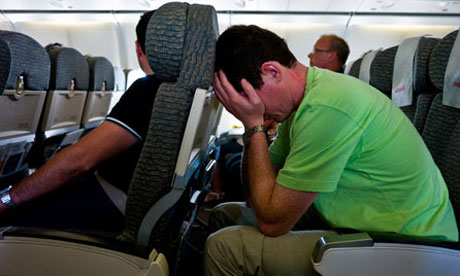
Help For Travelers With Flying Phobias

The Daily Mail: My name is Jenny Coad and I am afraid of flying.

And I am not alone. There are more than 12 million of us sufferers in the UK, all of whom are terrified at the idea of being 35,000ft up in the air in a vast metal bird.

This is what brings me to a bland, windowless conference room at Heathrow Airport with 250 anxious people split into groups of ten. We are all, to various degrees, affected by The Fear. Some will fly, but only in a state of sweaty paralysis. Others cannot even contemplate boarding a plane, not even to visit loved ones.

We all need help - and have signed up to Virgin Atlantic’s 'Fear Of Flying' course - a programme that is designed to unmask fear, teach us how to conquer it and become content (or at least calm) flyers. The answer isn’t a stiff gin – though I usually find that wonderfully soothing. Too much of the dulling drink and you could end up caught short in a Gerard Depardieu-style pickle.

Our instructors believe that knowledge is power. Their aim is to explain everything about the physics of flying, from how a plane takes off to why it doesn’t matter if lightning strikes (the fuselage, we are told, acts as a 'Faraday’s Cage', spreading the electrical charge over the plane’s surface and protecting the interior).

Even better is the news that turbulence is safe, only uncomfortable, and all those alarming bumps are only inch drops in terms of altitude. These are caused by slight changes in temperature and unstable air. I will try to remember this next time I’m on a wobbly flight. It might just stop me from grabbing the leg of the person sitting next to me – particularly embarrassing when it's snuggly newly-weds.

It is reassuring too, to hear that the wings are virtually indestructible. They won’t simply fall off mid-flight – so there is no need to watch them intently, waiting for signs of impending disaster. To me, this all sounds hugely reassuring. But some people in the room haven’t flown for years - one of them because of a ‘mid-air incident’ that he refers to in sinister tones.
Others fear they may pass out, panic, lose control. But we’re all in this together - and concerns, ranging from worries for the health of the pilot to whether the aviation industry is conspiring to withhold the true risks associated with flying - flood the room.

When people ask, ‘how does the pilot know if the wheels have gone down, what if he forgets to shut the doors, what if he’s hung over?’, I wonder how Captain Dave Mabbett - who has flown over 40,000 engine hours and presumably knows a thing or two about aviation - manages to keep his cool.

He does, admirably, and answers everything – and if he can’t, he promises to find out. He explains the complete importance of safety within the airline industry. Air travel, as well as being the safest mode of transport, is constantly improving, he says. There are accidents, but all of them are investigated and lessons quickly learned.

Captain Dave doesn't avoid talking about past crashes. These serve, for many, as examples of why you would be mad to fly. Take the horror of Air France flight 447, which plunged into the Atlantic in 2009, resulting in the deaths of all 228 passengers.

The speed measuring device, which iced up on that particular model of the Airbus 330, was immediately modified on all aircraft. Pilots now attend a training programme outlining exactly what to do when faced with that situation. They are taught to prepare the plane as if for a normal landing by lowering the nose towards the horizon. The aircraft will act like a glider, reach what’s called a ‘known speed’ of roughly 280 miles per hour, and come down at approximately 1000 feet per minute.

David Nott, a 'Cabin Safety and Security Training Instructor', is also on hand too to dispel a few myths about the role of crew on board. They are not just there to sell cigarettes and alcohol. Did you know that all cabin crew members are medically trained? That they can assist with on-board births (one baby girl born on a Virgin flight was named Virginia – poor thing)? That they know exactly how to treat panic attacks and are able to administer life-saving first aid? Training is rigorous and they are re-tested constantly.

Facts, though, aren’t always enough. This is where Geoff Rolls, assistant to Paul McKenna and our hypnotist (I’m not kidding) for the day - comes in. He is here to trick us into flying with confidence – and even enjoying it - again. And not with gin.

Rolls has us tapping our foreheads, pinging elastic bands on our wrists and even holding our tongues. It might sound silly, but this is designed to be a distraction. Holding my tongue and trying not to giggle is certainly diverting. But the technique worked for the aviation-phobic Whoopi Goldberg. The Fear Of Flying team flew to the US to give her one-on-one tuition in 2009. She crossed the Atlantic on her own, quite happily, soon after.

So we take to the air. Up, up and away. Flying with a plane load of petrified passengers is not fun. But the flight is part of the cure. While in the air, the pilot explains exactly what is happening when the plane banks, the engines growl or discomforting mechanical noises sound. I am sitting next to a pale-looking father who hopes to iron out his, and his daughter’s, fears. She’s here too, and so is his wife. He tells me, ‘I usually throw up on flights, so I’m hoping that today will help me with that.’ Me too.

It’s a great relief, for everyone, to land on firm ground. Certificates are handed round, tears wiped away and elastic bands pinged for the last time. I have flown since and, despite it being with Ryanair, found the experience a relaxed one.

The Fear Of Flying course is not a jolly day out. But when you’ve recovered from the experience, you might find that your fear of flying has gone. Otherwise, I’d recommend sticking to the gin and tonic.

Paris Air Show - Day 4

Airbus A320neo
Associated Press: Airbus is trouncing Boeing in the race to be the world's biggest planemaker, claiming over $72 billion dollars worth of orders and commitments at the Paris Air Show, where the popularity of its new fuel-efficient jets twice broke records for the largest order ever.

Airbus' success cast a long shadow over Chicago-based Boeing, which recorded only $22 billion in orders and commitments, and raised questions over the U.S. planemaker's ability to compete in a market dominated by concerns over high fuel prices.

Airbus CEO Tom Enders and AirAsia CEO Tony Fernandes signed off Thursday on an $18.5 billion order for 200 of Airbus' new A320neo aircraft, which has proven to be the star of the aviation industry's premier event. The order is the largest ever, eclipsing the previous record set just Wednesday by another A320neo customer, Asian carrier IndiGo. Airlines often negotiate discounts on large deals.

The recipe to Airbus' gains over Boeing is deceptively simple. It modified its existing workhorse jet, the A320, with improved engines and modified wingtips to make it allegedly 15 percent more fuel-efficient than Boeing's 737. The plane will only start delivering in 2015 but Airbus is using it now to cash in on airlines' need to reduce sky-high fuel costs and cut carbon dioxide emissions.

Airbus' Enders said the A320neo was now "by far the best-selling airliner in the history of commercial aviation." The company has over 1,000 orders or commitments for the plane, including 667 during the air show's first four days.

Airbus' success increases the pressure on its U.S. rival to respond to the challenge with either a revamped version of its own 737 or an entirely new aircraft. Boeing says it will make that decision in the coming months. It played down the orders rivalry, saying it doesn't keep deals in reserve just to announce them at air shows. It recorded orders and commitments for 142 aircraft worth $22 billion at catalog prices during the show. That includes a commitment from an undisclosed customer for it's hulking new 747-8 Intercontinentals worth $4.7 billion.

At this pace, Airbus looks likely to retain its position as industry leader for a fourth year running. Last year, it took in orders for 574 new aircraft worth $74 billion at list prices, more than Boeing's 530. The biggest orders for Airbus planes this week have come from the fast-growing countries in Asia and the Middle East. Besides AirAsia and IndiGo, Airbus also nabbed orders and commitments from the U.S. airline JetBlue and Garuda of Indonesia.

Boeing's highlights included a $1.7 billion order for 6 777 long-haul aircraft from Qatar Airways and 10 737s from Malaysian Airlines.

Though Airbus was ending the show with a bang, it had started off with a series of embarrassing gaffes before the opening. Its A380 double decker superjumbo was briefly grounded after it clipped a wingtip while maneuvering on a taxiway at the Le Bourget airport outside Paris, where the air show is held every two years. Airbus' long-overdue and over-budget military transporter, the A400M, was unable to perform a scheduled demonstration at the show because of what Airbus called a minor gearbox problem.

And the Airbus A350 long-range widebody had a new disappointment with the announcement that two versions of the jet would be delayed by about two years, so that the jet's exclusive engine supplier Rolls Royce can develop a higher powered motor for the stretched version of the aircraft, something Airbus said customers had demanded.

Although deals are typically announced during the first four days, before the opening to the general public on Friday, the planemakers held out hope for some last-minute surprises, possibly more orders.

"The show's not over yet," said Airbus CEO Enders.

Paris Air Show - Day 3

ABC News: Airbus racked up huge orders for its fuel-saving A320neo jetliner on Wednesday, even bagging the biggest single sale in aviation history, and overshadowing the arrival of Boeing's much-hyped and much-delayed 787 Dreamliner at the Paris Air Show.

As airlines around the world worry about skyrocketing fuel prices, demand has surged for low-consumption planes. Airbus' A320neo, which the company claims is 15 percent more fuel-efficient than rival Boeing's 737 thanks to an improved engine and modified wingtips, was the undisputed star of the Paris Air Show, the industry's biggest annual event.

Airbus notched an order for 180 aircraft from Indian low-cost carrier IndiGo, the biggest single order a company has received in terms of planes. Other orders for the A320neo came from Chilean carrier LAN Airlines and Kuwaiti leasing company ALAFCO, while U.S. carrier Frontier Airlines and Latin American carrier AviancaTaca made commitments for 131 more.

Airbus has now racked up more than 600 orders and commitments for the A320neo since it began marketing the jet last December. Airbus' top salesman John Leahy told reporters that orders for the A320neo could top 1,000 by the time the Paris Air Show ends this weekend, providing powerful confirmation of Airbus' decision to adapt its workhorse A320 to meet airlines' growing concerns over fuel costs.

The jet's success also poses a direct challenge to Chicago-based Boeing, which has yet to decide whether to respond with an upgraded 737 itself or to launch an entirely new aircraft.

Indigo ordered 150 of the A320neos and another 30 of the standard A320 single-aisle short and medium haul jets. The firm order follows a memorandum of understanding signed by the two companies in January. Airbus said then that the deal was worth $15.6 billion at list prices, though airlines usually negotiate discounts.

The deal topped the previous record for biggest aircraft order held by China's Central Aircraft Sales Corp., which ordered 150 aircraft from Airbus and the same number from Boeing in 2005.

Boeing was hoping to draw attention away from the Airbus' order tally to its wide-bodied 787 jets with a launch order from All Nippon Airways, who will take delivery of the first model as early as August. At a joint ceremony at the Paris Air Show, the two companies showcased the new plane — known as the Dreamliner — saying it will allow carriers to open up a number of new long-haul routes.

"Its delivery is planned for August or September this year," said Shuichi Fujimura, vice president of All Nippon Airways, or ANA. Developmental problems have delayed the new-generation jet's introduction into passenger service by three years. More than 800 have so far been ordered by over 50 airlines. Fujimura said ANA expects to receive 14 Dreamliners by next March. ANA has a total of 55 787s on order.

"We have a target to expand our route network, and the 787 will play a significant role in that plan," said Fujimura, who was speaking at a news conference together with Scott Fancher, Boeing's 787 program head.

The twin-engine 787 is made mostly of carbon fiber and other composite materials, which make it lighter and therefore more fuel-efficient than other mid-sized airliners. Its twin-aisle passenger cabin accommodates up to 250 passengers.

Because of the 787's improved range, ANA plans to use it on a number of new long-haul routes that were not previously commercially viable because there were not enough passengers to justify using larger aircraft such as the Boeing 747, Fujimura said.

The plane made its debut at the Paris Air Show when it arrived direct from Seattle late Tuesday.

Paris Air Show - Day 2

Wall Street Journal: The world's commercial-aircraft manufacturers racked up orders for more than 150 planes valued at more than $10 billion on the second day of the Paris Air Show despite growing concerns about the health of the global economy.

After a blockbuster opening day Monday, there was no letup in the pace of orders Tuesday with Airbus and Boeing Co. announcing more huge commitments.

"Airlines are fundamentally stronger than they've been in years," said Jeff Knittel, president of transportation finance at CIT Group Inc., one of the world's largest aircraft-leasing companies. "Consolidation in the U.S. has yielded better balance sheets, and airlines in the U.S. and western Europe are more disciplined on capacity than ever before.

"It's two stories: In the U.S. and western Europe, airlines are replacing older planes. And Asia, the Middle East and Latin America are growth markets."

CIT on Tuesday ordered 50 A320neos at a list price of about $4.6 billion as the fuel-efficient Airbus model once again stole the limelight, snaring the biggest deals of the day in terms of price and numbers of planes. Customers typically negotiate substantial discounts on bulk buys.

Airbus, a unit of European Aeronautic Defence & Space Co. NV, Tuesday booked orders for 121 aircraft from the A320 family of single-aisle commercial jets after taking orders for 142 planes Monday. The 263 aircraft booked over the first two days represent a value of $26.1 billion at list price and bring to 594 the number of orders booked by Airbus since it launched the A320neo program in December.

The European aircraft builder had predicted that its order book for A320neos would swell to at least 500 by the time the air show ends later this week.

Airbus says that the A320neo—the "neo" stands for "new engine option"—will enter service in 2015 and will offer 15% fuel reduction compared with existing versions of the plane. The reduction in fuel burn is equivalent to 1.4 million liters of fuel a year—the consumption of 1,000 midsize cars—saving 3,600 metric tons of carbon dioxide per aircraft, or the amount absorbed by 240,000 mature trees, according to Airbus.

CIT ordered 60 PurePower PW1100G engines and booked options for up to 40 more from Pratt & Whitney, a unit of United Technologies Corp. It also ordered Leap-X1A engines to power 15 A320neos from CFM International, a joint venture between General Electric Co. and France's Safran SA, with an option for engines for another 10.

Other A320neo orders Tuesday included one for 40 aircraft from JetBlue Airways Corp. of the U.S. and one from Garuda Indonesia for 15 standard A320s and 10 A320neos.

There was a firm order from Taiwan-based TransAsia Airways for six re-engined versions of the stretched A321.

Airbus already has bettered its performance at Farnborough, England, last year, when it took in customer commitments for a total of 255 aircraft valued at $28 billion, including 133 firm orders worth more than $13 billion. The order inflow at Airbus is expected to continue. Airbus has scheduled two announcements for Wednesday and possibly one Thursday.

Boeing picked up an order for 15 737-800 aircraft worth $1.2 billion at list prices from low-fare carrier Norwegian Air Shuttle ASA, while late Monday in Washington MIAT Mongolian Airlines ordered two 737-800s and one 767-300ER in a $245 million deal. Malaysian Airline System Bhd. exercised an option to buy 10 737-800s for $800 million at current list prices.

Russian carrier OAO Aeroflot will receive eight long-haul 777-300ERs. The order was previously attributed to an unidentified customer on Boeing's orders and deliveries website.

China Claims Place at Paris Air Show

China's Passenger Jet C919
AFP: China aims to claim its rightful place at the Paris International Airshow this week alongside giants Airbus and Boeing, laying down a marker for its ambitions to be a major player in global aviation.
Airbus and Boeing dominate the hugely important Chinese market but Beijing has long made clear its intentions to make its own aircraft, moving swiftly up the technological ladder, just as it has in so many other products. Its immediate target is the medium-haul segment, carved up between Airbus with its A320 twin-engined series and Boeing's similar 737, the largest selling commercial aircraft since its launch in 1967 and a mainstay in Chinese skies.

Commercial Aircraft Corp of China (Comac) makes its first appearance at the Le Bourget airshow next week just north of Paris, with a mock-up of the cockpit and part of the fuselage of its C919 model. Currently under development, the 190-seat C919 is due to enter service in 2016, just after Airbus brings its upgraded and already much sought after A320neo to the market, raising the question of whether China's first commercial jet can make inroads against such tough opposition.

For the moment, Comac has won orders for some 100 C919s from Chinese airlines but has found only one foreign customer - the leasing arm of US conglomerate General Electric. The company is clearly hoping for more by setting up its stall at Le Bourget, analysts say.

"They want to talk to companies and to bring them up to date with how the (C919) project is going," said Christophe Menard, aerospace analyst with Kepler.

"There are discussions underway with a number of Western aviation companies," said Jean-Paul Ebanga, head of CFM International, the Franco-American firm supplying engines for the C919.

For the airlines to take the C919 seriously, there are the key issues of its airworthiness certification, its performance and delivery date to be resolved. To ensure it can bring the C919 to market successfully, Comac, part of the giant China Aviation Industry Corp (Avic), has joined up with several major Western groups -- CFMI for the engines, France's Michelin for tyres and Safran for the cabling of the aircraft.

"We have settled on a timetable and things are moving on. We have no reason to question the rationale of the programme," CFMI head Ebanga said.

For Menard, Comac's tie-ups with the Western companies are clearly intended to "bolster the credibility of the project" and reflect a simple truth -- if it is to stand any chance against Airbus and Boeing, it needs foreign help.

In March, the company announced another tie-up, this time with Canada's Bombardier which is also trying to break into the medium-haul market based on its experience in smaller passenger jets. "In terms of the airframe (fuselage and wings), Comac should benefit from Bombardier's experience," Menard said.

The accord with Bombardier will no doubt "help accelerate" the C919 project but for Airbus and Boeing, Comac still presents no immediate threat, he said.

"For them, it is a competitor but the threat is not for right now but for the medium-term, looking ahead to around 2020," Menard said.

At the same time, Comac will be just one of several likely new entrants to the highly competitive market, with Bombardier and Brazil's Embraer making great strides. "There will be other aviation companies, Chinese, Russian," Fabrice Bregier, the Airbus number two, said recently.

Airbus and Boeing will have to face a number of new competitors by 2030 and they will have to prepare for that, making sure that they "anticipate developments and invest in new technologies," Bregier said.